
Once upon a time… when time had a slower pace, and the world seemed a simpler place, even the movement of money was easier to understand. And if you ever wondered „why?”, it's because, long ago, money was correlated with gold. Simply put, banknotes could be exchanged for gold, and printing money was generally constrained by gold reserves, which imposed a stricter monetary discipline.
Today, the perspective has changed, and the movements in the gold market over the past weeks show us that even the "safest asset" in the market can hold surprises for us. What they look like, exactly, we invite you to discover together in an episode golden from The MacRO Zone.
FROM CURRENCY TO FINANCIAL ASSET
Historically, gold has functioned as money precisely because it has rarity, durability, divisibility, and universal acceptance. The 20th century marks the gradual transition from gold-based systems (including the gold standard) to fiat regimes (fiat monetary regimes are monetary systems in which the currency has no intrinsic value, is not convertible into gold, silver, etc.) and, subsequently, to a world dominated by credit and central banks.
The decisive break came with the suspension of the dollar's convertibility into gold under the system Bretton Woods, through what has remained in history as The Nixon Shock, the day when gold transformed from the formal ”anchor” of the currency into a freely traded financial asset on the market.
〽️ This moment was the change that created, the modern gold: an asset with a price determined by supply-demand, macro expectations and flows, traded globally, in which the monetary role survives mainly through investor behavior and central banks' decisions.
WHY IS GOLD CONSIDERED A SAFE HAVEN
At the portfolio level, gold is often treated as diversification tool or as a protection alternative against financial losses (hedge) or extreme risks. It is classified as a historic refuge, due to the following characteristics:
|
| |
|
| |
|
| |
| ||
ENDORSED BY THE CENTRAL BANKS
One of the clearest signals comes from the realm of central banks that use gold as an element of diversification of reserves and as credibility instrument in periods of tension. In the last five years, the pace of acquisitions has been remarkable, according to World Gold Council, acestea au cumpărat constant cantități mari de aur 2021 (726 tone), 2022 (1,037 tone), 2023 (1,082 tone), 2024 (1,092 tone), respectiv 2025 (863 tone). Analizând aceste cifre, putem deduce faptul că, într-o perioadă în care tensiunile geopolitice sunt accentuate de fragmentări economice și state cu datorii mari, aurul se transformă într-un activ de credibilitate.
ROMANIA
For Romania, the strategy is different and is based on quantitative stability. More precisely, the NBR maintains the constant reserve from 2007 (103.6 tons), but what has changed dramatically here is the value.
That is how it happens that, if in 2016, the national bank's gold reserve was worth 3.66 billion euros, in 2026 it reaches the threshold of 14.22 billion euros. Practically, we are talking about a multiplication of the value about 3.3 times in 10 years for the same physical stock.
THE MOVEMENTS ON THE GOLD MARKET
Gold, expressed through the XAUUSD quotation (price/ounce of gold, expressed in dollars), has undergone in the last 12 months one of the most tumultuous periods in its modern history. Thus, we observe that if, traditionally, the metal is perceived as a defensive asset, with low volatility and a stabilizing role at the portfolio level, recent data shows us the transition into an asset marked by extreme movements, high risk, rapid repositioning, and high volatility.
Looking at the figures, gold's performance over the past year is astonishing: at the beginning of 2025 it was at 2,856 USD/ounce, at the beginning of February it closed at 4,894 USD/ounce. Basically, we are looking at a annual yield of approximately 71.36%, with an annual variation interval of almost 90% between the minimum (2,857 dollars) and maximum (5,417 dollars).
For an asset with safe haven status, such performance is exceptional and suggests not only increasing demand but also active participation of speculative capital, attracted by momentum and the rapid change of macroeconomic expectations.
GOLD PRICE EVOLUTION
Aug 2025 - Feb 2026 | USD/ounce
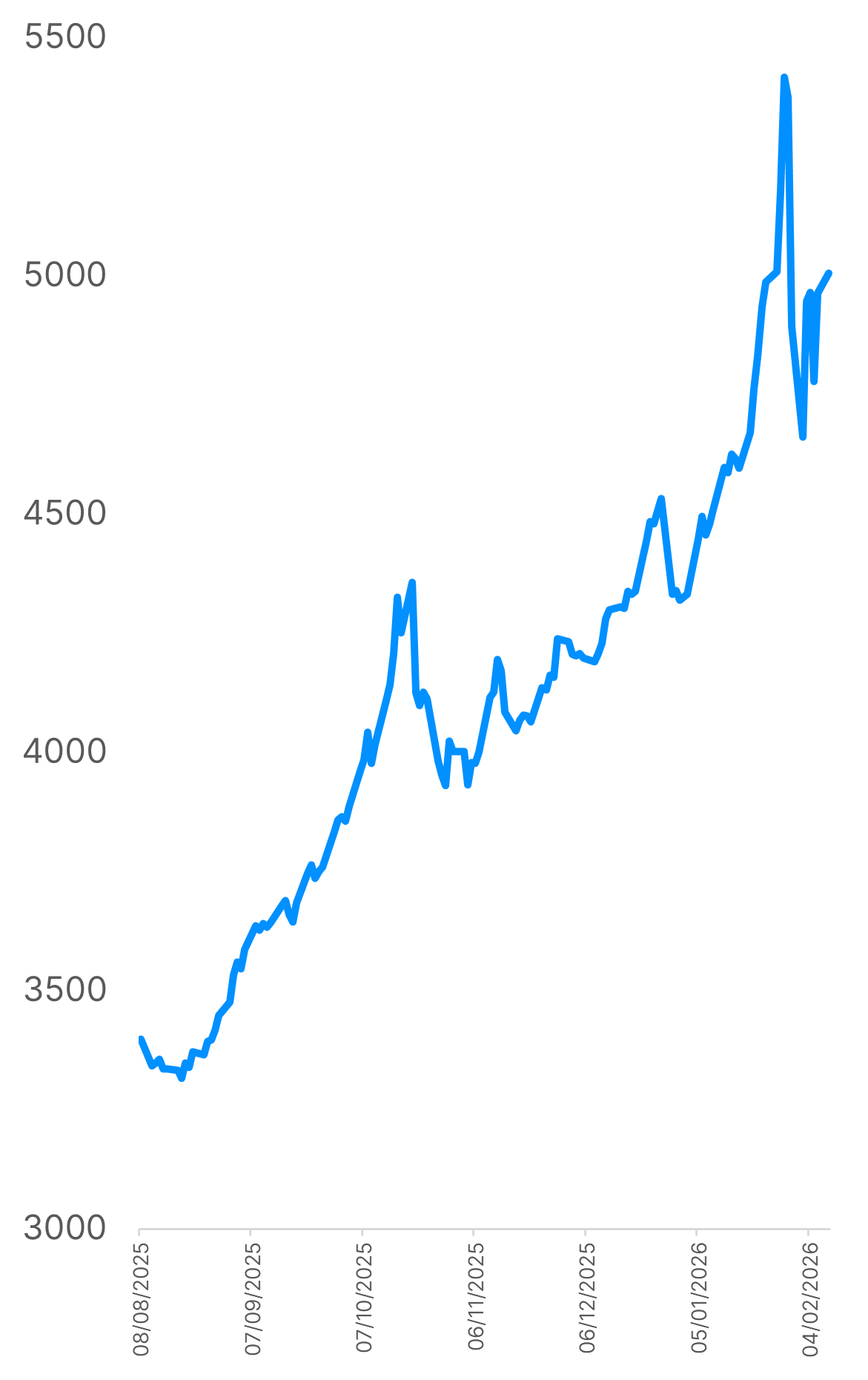
- Aug - Sep 2025: The price rises slowly, almost linearly, which represents a sign of constant accumulation.
- Sep - Oct 2025: The slope is accentuated due to increased geopolitical tensions (instability, sanctions, USA-China trade tensions) that have weakened the dollar and have prompted central banks to purchase gold at record levels.
- Oct - Dec 2025: The price fluctuates, but does not return to previous levels. Pressure on the US dollar and interest rate cuts by the Fed motivate investors to turn to a safer asset.
- Jan - Feb 2026: On January 28, gold reaches all time-high, through a major spike to the level of $5,417.21/ounce. It reaches the highest level since 1976 to date and thus repositions itself as a geopolitical anchor in a highly volatile context. The correction comes along with the intention to nominate Kevin Warsh to lead the Fed.
WHY SO MUCH VOLATILITY?
In a short answer, because I saw how several forces act simultaneously:
- Structural Demand
- In 2025, the total demand for gold, including over-the-counter (OTC – direct, unmediated exchanges between two parties) transactions, exceeded, for the first time, the threshold of 5,000 tons.
- Central banks have continued to be heavy buyers, with more moderate purchases compared to 2024, but still high compared to the average (863 tons of gold).
- Refuge Request or "Safe-Haven Bid"
- On the background of international political tensions, investors tend to flee risk by selling volatile assets (stocks, crypto) and moving money into gold to preserve the value of portfolios.
- When such a moment occurs (as we saw at the beginning of the year 2026), several investors in the market meet, a moment when the price tends to jump abruptly.
- American monetary policy
- Extreme volatility at the beginning of this year also came from the area of US monetary policy and expectations regarding the Federal Reserve. Announcements and speculations related to the nomination of Kevin Warsh to head the Fed triggered a rapid repositioning of the dollar and rates, and gold, already in a zone of technical overheating, reacted strongly.
- Extreme volatility at the beginning of this year also came from the area of US monetary policy and expectations regarding the Federal Reserve. Announcements and speculations related to the nomination of Kevin Warsh to head the Fed triggered a rapid repositioning of the dollar and rates, and gold, already in a zone of technical overheating, reacted strongly.
A BATTLE OF HAWKS AND DOVES
Analysis of the last months and the last year shows an extremely performant gold in terms of yield, but with an unusually high risk cost. This combination of strong trend and high volatility defines the essence of the analyzed period and explains why gold from the last months can no longer be viewed exclusively through its traditional role as a safe haven, but also as an asset profoundly influenced by global financial dynamics and the microstructure of modern markets.
Looking ahead, gold remains caught between two forces. On the one hand, the structural demand for diversification of reserves and the appetite for real assets in a complex geopolitical context provide it support. On the other hand, at very high price levels and after sharp increases, the market becomes vulnerable to repricing, at the strengthening of the dollar or at the defusing of some perceived risks.