
When it comes to the real estate market, the situation is quite simple, everything is overpriced. And if you have thought about buying an apartment in recent years, you have probably seen with your own eyes the price increases. At the end of 2025, there were developments from +6% (Servus, Cluj!), which brought the average square meter in Cluj-Napoca to about 3,230 euros/sqm and up to +22% (Hello, Bucharest!), that is one square meter of approximately 2,200 euros in the capital.
However, I have learned that, when we talk about economics, the truth becomes nuanced, depending on the types of figures we look at. For example, housing prices can be nominal (lei /euro), those displayed in sales advertisements, but also taking inflation into account and thus to see real increases. Welcome to a new The MacRO Zone where we will analyze what the numeric difference between rent and purchase looks like, and how we compare with other European countries.
A DECADE IN WHICH THE PACE HAS ACCELERATED
To begin with, we propose a look at the European perspective, where, in the period 2015 – 2025, we have often heard that a trend is forming whereby the neighbors from the West prefer to rent rather than buy a home. Even if the trend is based on a social foundation different from that of Romanians (after the communist period, the sense of ownership here developed so strongly that we ended up being the country with the most owners in the EU - 94,3%), the choice of rentals as a mode of living was not a trend based on social factors, but also on economic ones.
|
The structural trend shows us that property has become increasingly difficult to attain, not because demand has disappeared, but because real estate assets have appreciated at a faster pace. In simple terms, access to property has become more limited, and neighbors in the West have turned to alternatives.
QUARTERLY GROWTH RATE OF HOUSING PRICES AT EU LEVEL
%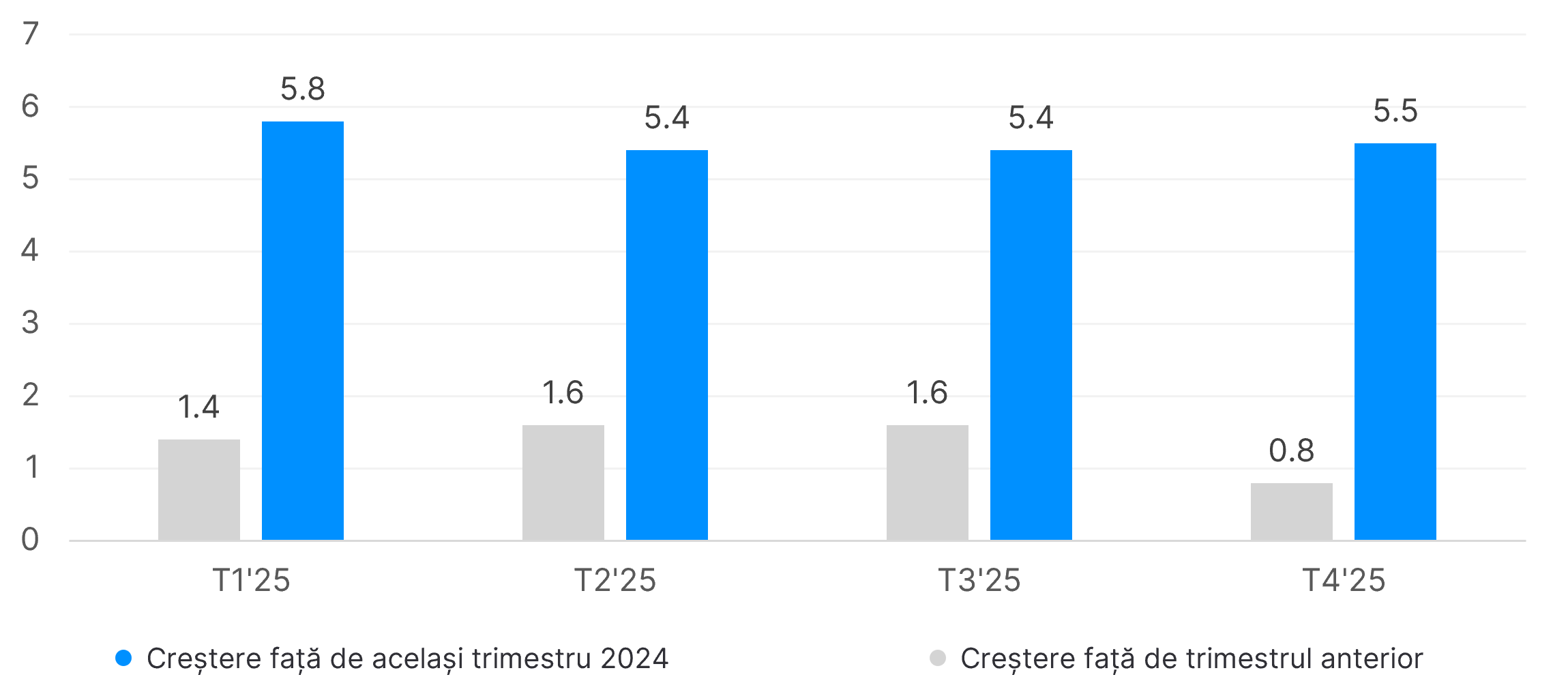
- As we can see, the rate of growth of house prices at the EU level has shown us a 2025 of consolidation, not of further explosion. The rates remained high, but towards the end a slight tempering was observed in the quarterly comparison.
- In Q4 2025, the largest annual increases the housing price increases in the EU were recorded in Hungary (21.2%), Portugal (18.9%), and Croatia (16.1%).
- At the opposite pole, the only annual decrease was in Finland (-3.1%), while the weakest positive results were in Luxembourg (0.1%) and France (1.0%).
- In Q4 2025, the largest annual increases the housing price increases in the EU were recorded in Hungary (21.2%), Portugal (18.9%), and Croatia (16.1%).
- These differences show a very heterogeneous European market: some countries were still in a phase of rapid appreciation, while others remained almost stagnant or even in correction. Thus, when it comes to the European real estate map, we cannot say that we are looking at a single market, but at dozens of local markets with their own logic, directly influenced by national social, political, and economic factors.
QUARTERLY GROWTH RATE OF HOUSING PRICES AT THE LEVEL OF ROMANIA
%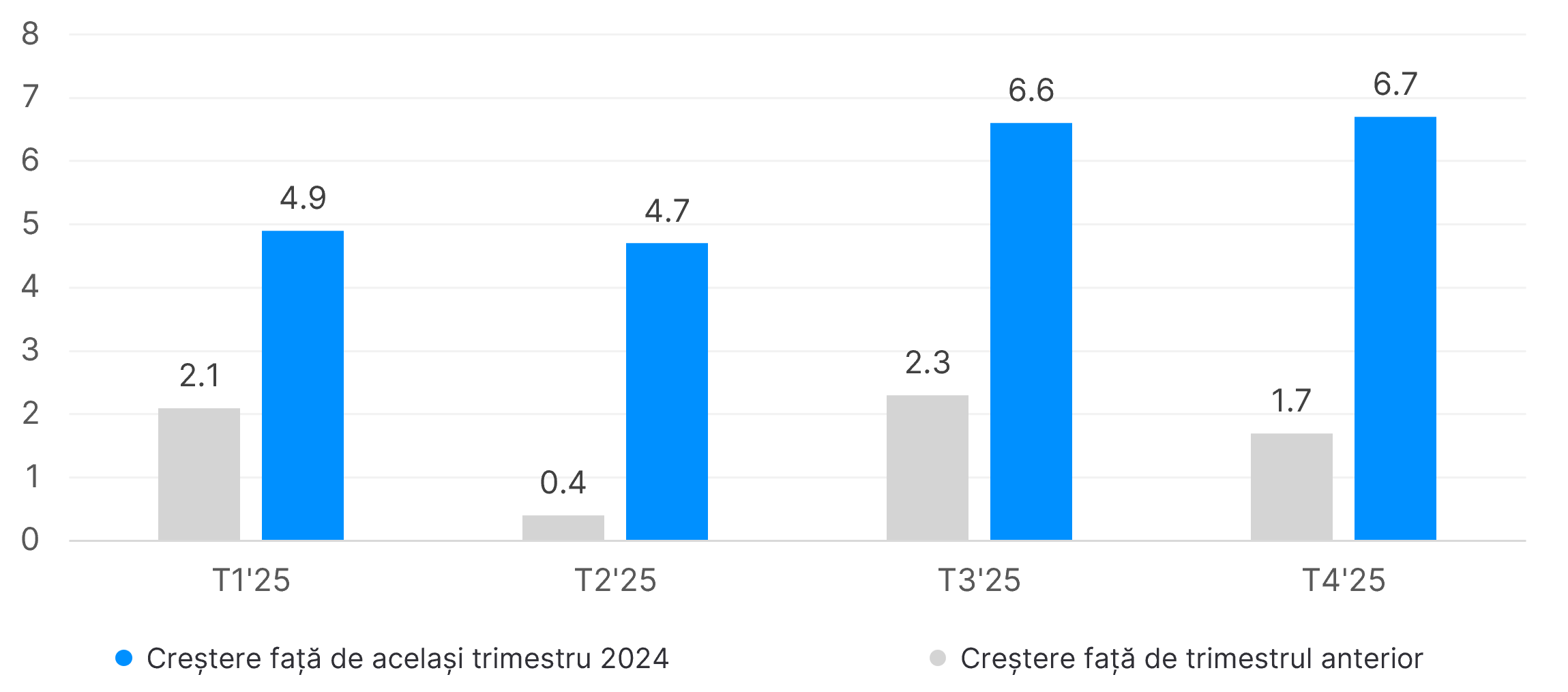
- Romania had an upward trend in all four quarters, so it did not enter any contraction phase in 2025.
- In the second half of the year, Romania's annual rate, of 6.6% and 6.7%, exceeded the EU average, of 5.4% and 5.5%, which shows a relative acceleration of the Romanian market.
- Comparative to European leaders, we remain in a zone of strong growth, but not exuberant, which places us in an intermediate category: more dynamic than the large and mature markets of Western Europe, but less tense than the markets with the fastest price increases in Central and Southeastern Europe.
WHAT HAPPENS AFTER INFLATION DECREASES?
Here the nuances appear, because not everything that grows nominally also grows in real terms, and the market in Romania in 2025 illustrates this rule best. Although Romania grew by 6.7% vs Q4’24, when we subtract inflation from the equation, the perspective changes and even becomes negative.
REAL INCREASE IN HOUSING PRICES
% | AN/AN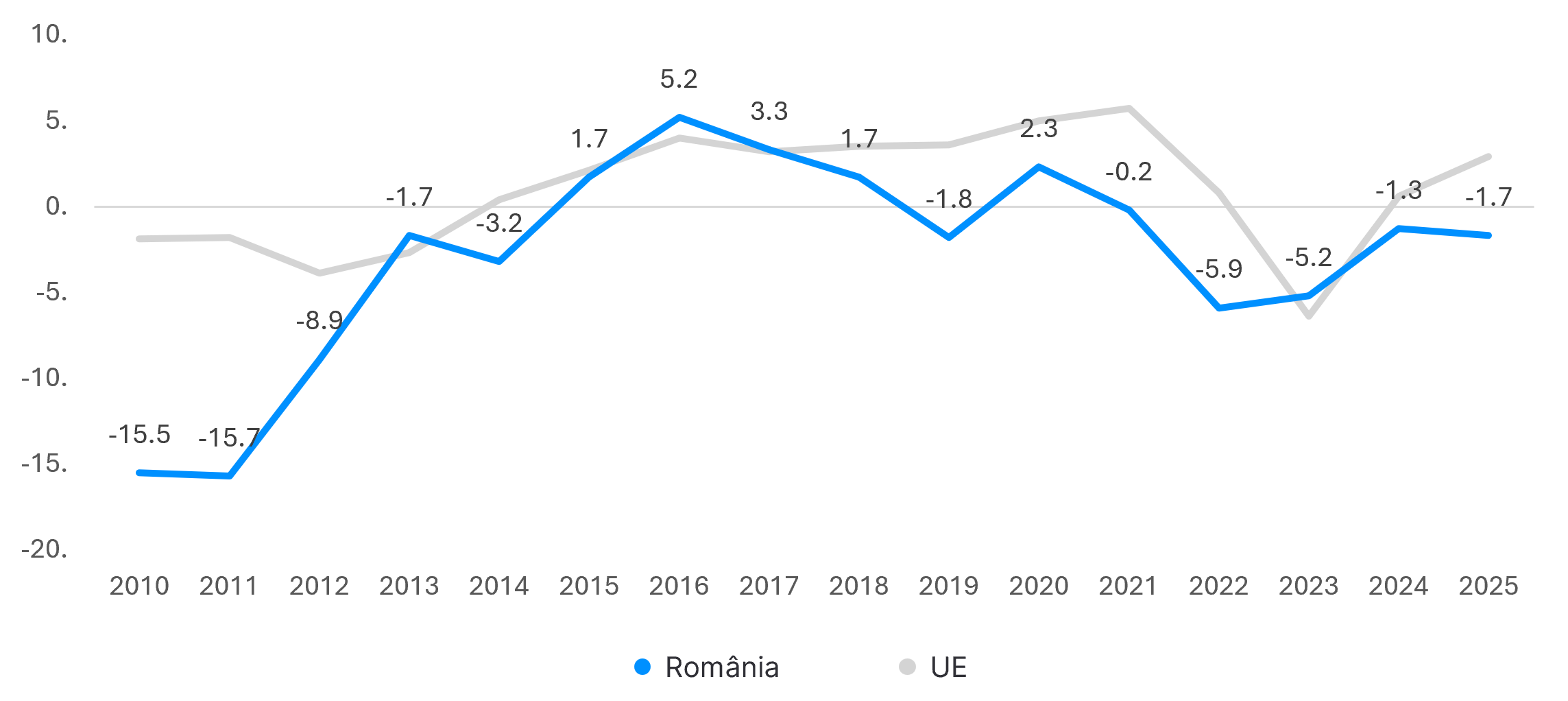
- With 5 consecutive years (2021-2025) of real decrease, inflation has systematically eroded a good part of the nominal growth.
Imagine that in 2022 you bought an apartment for €100,000. In 2025, you see it listed at €110,000 and you have the impression that you gained 10%. But in the same period, prices in the economy (food, utilities, services) increased by 15%. On paper you seem richer, but in reality you can afford fewer goods than before. |
- Romania has a real estate market with high nominal dynamics, but inflation has eroded a good part of that growth. Those who bought a home as an investment in 2022 or 2023 earned less in real terms than the displayed prices suggest.
- While, in Europe, deflated price increases in 2025 were in Portugal (+14.7%), Hungary (+11.7%) and Croatia (+10.0%), Romania (+1.7%) ranks among the last five countries in the EU, alongside Finland (-3.6%) and Sweden (-1.6%).
AND YET... IF THE PURCHASING POWER OF ROMANIANS HAS DECREASED, WHY DO PRICES NOT FALL?
Besides the fact that the real purchasing power has been eroded by inflation and that the number of transactions has decreased, nominal prices have not yielded. And if you are wondering what the reason might be, the answer lies in offer.
In 2025, in Bucharest and Ilfov, 17,300 homes were completed, the second smallest result in the last six years, increasing by only 1.8% compared to 2024. The new offer is small. And when the offer remains small and demand persists, nominal prices do not fall.
While the uncertainty of the national and international context has created a combination of structural factors (rising taxes, persistent inflation, and price increases for energy and raw materials) that push up both material and labor costs, it is most likely that new residential construction will remain low, and the supply relatively small.
ARE RENTS STILL AN OPTION?
Rents remain, theoretically, an alternative, but the figures show that this option is also becoming increasingly expensive. Between 2015 and 2025, in Romania, rents increased by approximately 60%, and housing prices by about 70%, both above the EU average, where prices rose by 64.9%, and rents by only 21.8%. In other words, Romania has not only become more expensive, but has become more expensive at an accelerated pace including in the „monthly rent payment”, not just in purchase.
Viewed more broadly, at the EU level, this gap between housing prices and relatively moderate rents has significantly eroded access to the property, mai ales pentru tineri și pentru gospodăriile fără active. Corecția abruptă din 2023, urmată de revenirea rapidă din 2024–2025, arată o piață extrem de sensibilă la costul creditului, susținută structural de lipsa de ofertă, asemenea unei piețe unde cererea revine mereu mai repede decât capacitatea de a construi.
ACCESSIBILITY, THE REAL STAKE OF THE HOUSING MARKET
Romania has a robust nominal real estate market, and that is not to be ignored. However, five consecutive years of negative real prices indicate that inflation has quietly stolen part of the growth. The real problem is not whether the market is growing or not, but that affordability is deteriorating: homes are becoming harder to buy relative to incomes, new supply remains insufficient, and construction costs will not decrease soon.
The long-term solution comes from more supply, faster authorizations, and more accessible financing options for the population. Without these, the discrepancy between those who already own an apartment and those who are trying to buy one will continue to increase.