
When we analyze the economic relations in Europe, the partnership between Romania and Hungary certainly deserves all the attention.
The two countries, united by a common border of 448 km and by historical, economic, and cultural ties, have developed a framework for economic cooperation based on geographical proximity, interdependence, bilateral investments, entrepreneurial spirit, regional collaborations, as well as common membership in the European Union and, more recently, the Schengen Area.
Mutual interest for business
Romanian investments in Hungary and Hungarian investments in Romania show mutual interest in investments. As we see, there is a difference given by the number of companies, influenced by factors such as the size of the economy, fiscal policies, expansion capacity or the diaspora.
In Romania there are over 15,000 companies with Hungarian capital, showing the interest of investors from Hungary in the Romanian market due to its size and geographical proximity. Also, a facilitator of these investments and collaboration is the Hungarian community in Romania.
On the other hand, there are approximately 7,000 companies with Romanian capital in Hungary, which indicates mutual interest in investments. Almost one fifth of the companies owned by Romanians in the EU are in Hungary, eMag, MedLife, AROBS being some successful examples.
- Hungary is Romania's third largest trade partner, after Germany and Italy.
- Hungary is ranked 11th among foreign investors in our country, based on the value of invested capital.
Top 5 companies from Hungary present in Romania are: MOL Group (energy), Richter Gedeon (pharma), MVM Group (energy), Wizz Air (transport), TriGranit (real estate).
Top 5 companies from Romania present in Hungary are: eMAG (online commerce), MedLife (medical services), Teraplast (manufacturing), AROBS (IT&Software), TTS Group (transport, logistics). The telecommunications company DIGI was present in Hungary for 23 years and sold its stake in 2022 (625 million euros) to the 4iG group.
Strategic directions of investments
In recent years, Hungary has strengthened its presence in the region through a coherent investment strategy in sectors with high strategic value. Among these, energy, transportation, tourism, and real estate stand out.
In the energy sector, the MOL and MVM groups play an important role in strengthening regional energy services, and in developing green infrastructure. Hungary invests in production and distribution capacities with a focus on sustainability and diversification of sources, and Romania is increasingly becoming an energy integration partner in the CEE region.
In transport, the presence of Wizz Air continues to be one of the most visible Hungarian investments, contributing to regional connectivity and the development of the low-cost aviation market. At the same time, companies from infrastructure and logistics have begun to explore common opportunities for expansion on the Schengen corridor, which facilitates the flow of goods and people.
The tourism sector is represented by the Danubius group, a major player in the hotel and wellness services area. It marks a constant orientation of Hungarian investors towards the exploitation of spa resources and health tourism – a rapidly developing segment at the regional level.
In the real estate market, the Kesz and Granit Real Estate groups confirm the increased interest in project development in Romania. The Granit transaction – one of the most important in the Bucharest real estate market – highlights the dynamics of Hungarian capital and the confidence in the potential of the local market.
On the other hand, Romanian companies continue to actively expand in Hungary, confirming the maturation of local entrepreneurship and the trend of internationalization. eMAG has strengthened its position in the online commerce market, becoming a regional brand, while MedLife marks an important step in the health sector, offering excellent premises for cross-border partnerships and investments.
These examples outline a common story of growth and integration: Hungarian companies invest in energy, infrastructure, and real estate – pillars of sustainable development – while Romanian firms assert their presence in commerce, health, and IT, sectors with added value and a direct impact on quality of life.
The Romanian-Hungarian partnership is expanding, toward internationalization and economic complementarity.
Economic relations Romania – Hungary, in numbers:
- In 2024, bilateral trade exchanges reached 13.3 billion euros, a slight increase (1%) compared to the previous year.
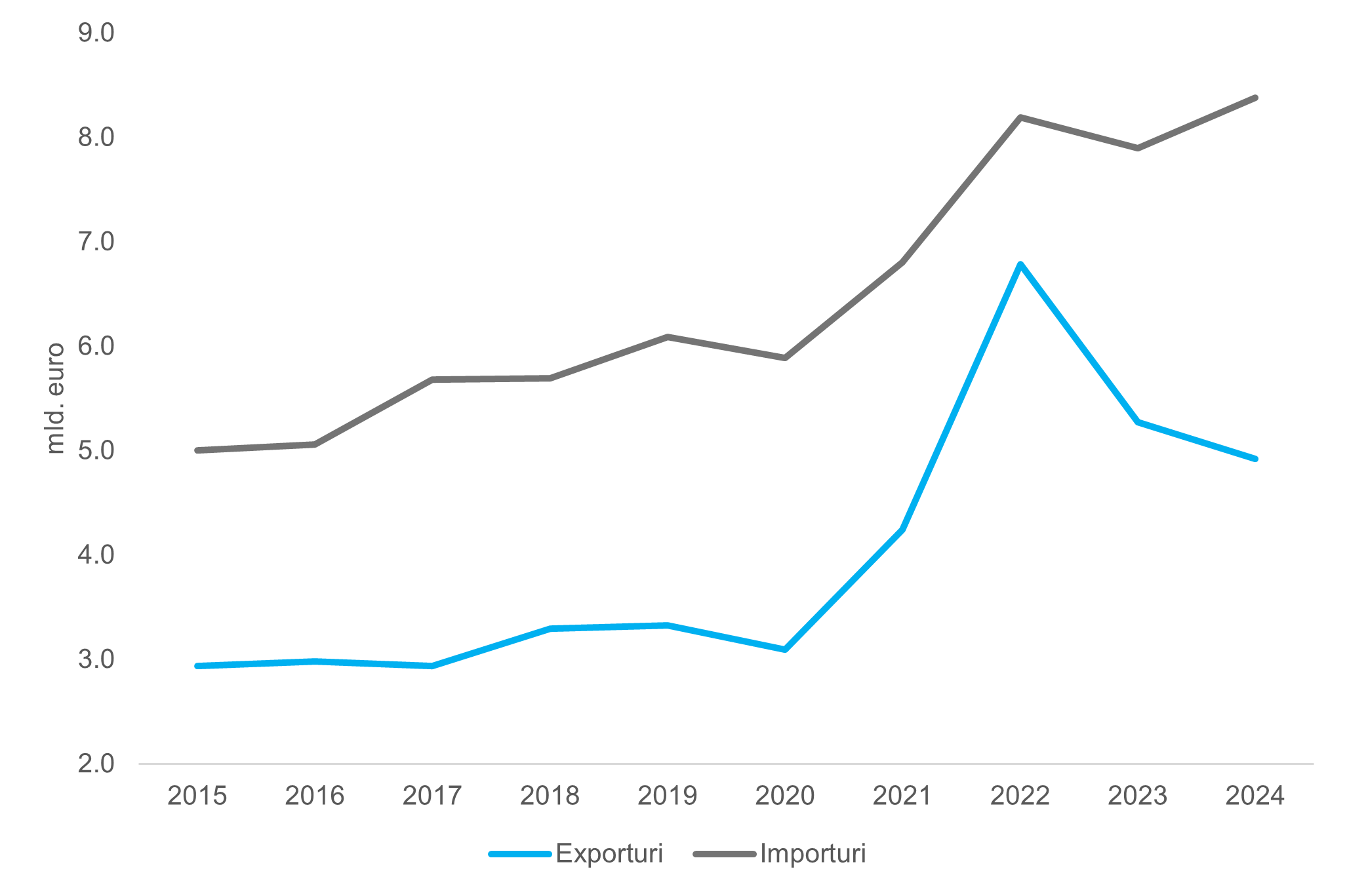
- Romanian exports to Hungary amounted to 4.92 billion euros, while imports from Hungary were 8.38 billion euros. Romania primarily exports to Hungary machinery, electrical equipment, mineral products, and vehicles, while imports are dominated by similar products, reflecting an industrial complementarity. Hungary exports more to Romania than vice versa. This imbalance is not necessarily surprising, considering the differences in industrial structure, but also from the point of view of competitiveness.
- Romania's membership in the Schengen Area shows the first results regarding opportunities for economic exchanges: +15.8% bilateral trade in the first quarter after the full integration of our country.
The evolution of recent years:
In the last ten years, Romania has had a negative trade balance with Hungary, importing on average 2.5 billion euros more per year than it exported. The year 2022 marked a record level of bilateral trade (15 billion euros), due to a combination of factors, including a strong recovery after the COVID-19 pandemic and solid economic growth in both countries.
Bilateral trade Romania-Hungary
Evolution 2015 - 2024
- On the other hand, exports of cars and electrical equipment recorded steady growth, exceeding 25% of total exports in 2024 (1.25 billion euros).
- Basic metals and derived products remain a stable component, ranking third among goods exported to Hungary.
- Minerals, machines and electrical equipment are among the most important categories of products that Romania imports from Hungary, which highlights the close connection between the two economies, especially in the industrial and energy fields.
- Both Romania and Hungary play an essential role as suppliers, as well as consumers of these strategic goods. Also, chemical products occupy an important place on the list of imports from Hungary (1.3 billion euros in 2024).
- Bilateral trade increased remarkably after Romania's full integration into the Schengen Area in January 2025: in the first three months of 2025, there was a 15.8% increase in bilateral trade, reaching approximately 3.5 billion euros in March and setting high expectations for future trade relations between the two countries.
Viewed as a whole, the economic relations between Romania and Hungary follow an upward direction, supported by bilateral investments, the complementarity of industrial sectors, and membership in the common European area. The Schengen area opens new opportunities in the commercial field, facilitating the free movement of goods and persons, as well as long-term strategic cooperation. As neighbors and partners, Romania and Hungary have the capacity to jointly stimulate economic prosperity both at the national and regional levels.