
There is a demographic paradox in the heart of Europe: while the population in certain countries is increasing, fewer children are being born, the average age increases year by year, and projections show that, in a few decades, there will be significantly fewer Europeans. Romania is experiencing the same story, but with an even more intense volume of decline.
And because, at The MacRO Zone, we solve paradoxes by interpreting the figures, today we invite you to take a look over demography, because, at the end of the day, it outlines the picture of tomorrow's workforce, future pensions, and domestic demand in the coming years.
DEMOGRAPHY OF EUROPE, SOME DATA FOR PERSPECTIVE
On 1 January 2026, the EU population reached approximately 452 million inhabitants, with nearly 706,000 more people than in the previous year.
It is a major change compared to past decades. If in the '60s the population of the Union grew by approximately 3 million people annually, in the last decade the rate has decreased to only about 600,000 people per year. In other words, Europe continues to grow, but the engine of this growth is no longer birth rate.
| NATURAL INCREASE It is, in fact, the difference between the birth rate (the number of people born) and the death rate (the number of people deceased) and is expressed in number of people per 1,000 inhabitants. When the birth rate exceeds the death rate, the growth is positive and the population increases; otherwise, it becomes negative, indicating a demographic decline. |
Since 2012, in the European Union, the natural increase is negative, and the only reason the European population continues to grow is positive net migration, meaning the number of people choosing to settle in member states exceeds the number of those who leave.
EVOLUTION OF THE POPULATION OF THE EUROPEAN UNION
2000 – 2026 | Millions
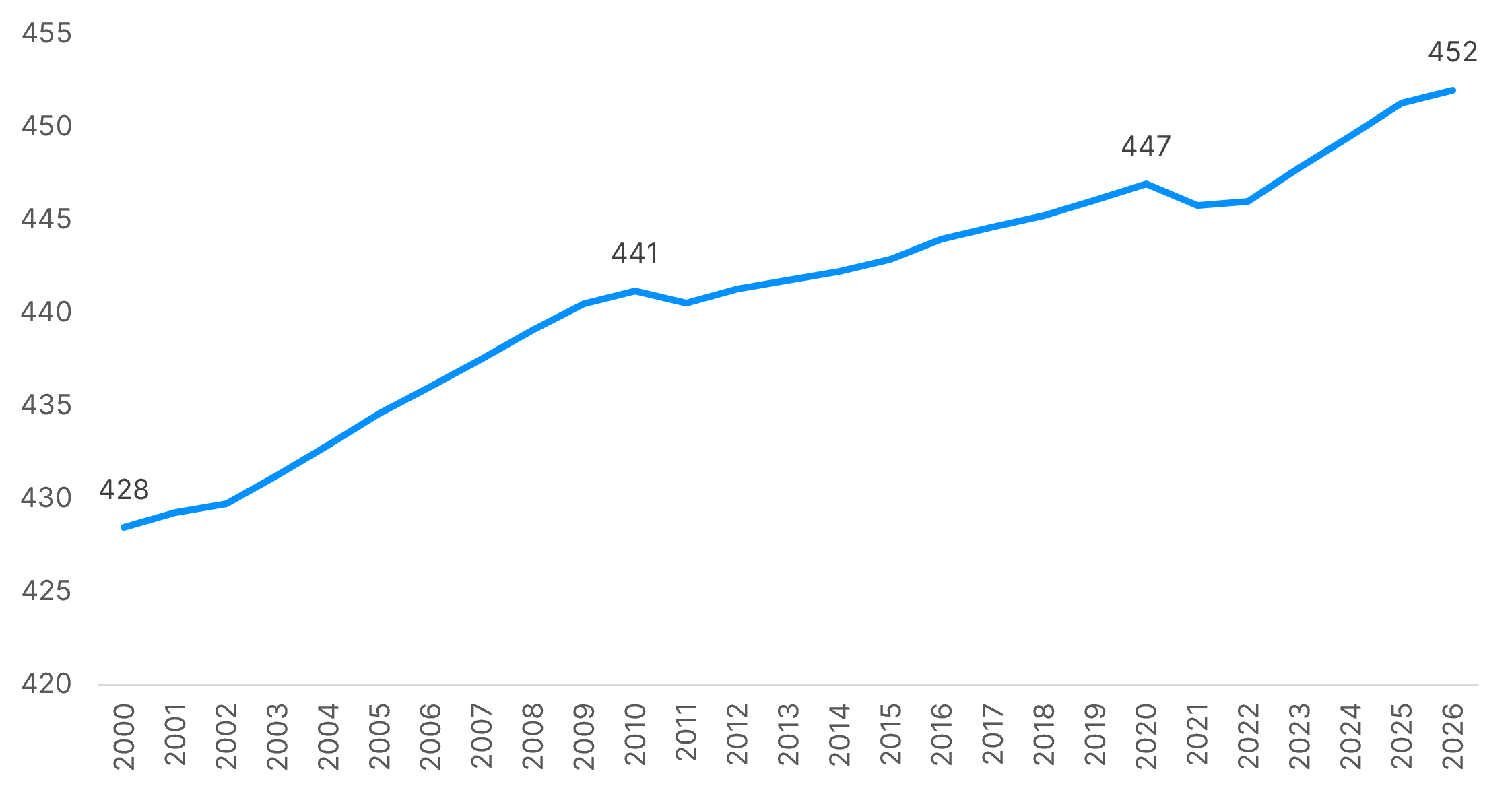
To analyze the dynamics of the states, we look at national populations, which, at the beginning of the year, ranged from 83.5 million inhabitants in Germany to only 0.6 million in Malta.
Primele 5 states concentrate approximately 2/3 of the total population of the European Union, and as distribution we observe:
Germany – 83.5 million inhabitants (18.5% of the EU population)
France – 69 million inhabitants (15.3% of the EU population)
Italy – 59 million inhabitants (13.0% of the EU population)
Spain – 50 million inhabitants (11.0% of the EU population)
Poland – 36 million inhabitants (8.0% of the EU population)
Romania remains in the group of large states of the Union in terms of the number of inhabitants, ranking sixth, with a population of 19 million inhabitants.
WHERE DOES EUROPEAN GROWTH STOP?
The most recent projections indicate a limited increase in the population in the coming years, followed by a prolonged period of decline, so that, if we look at the raw data, we observe the following trend:
2025 (451.8 MN) -> 2029 (453.3 MN) -> 2100 (398.8 MN)
Europe reaches the peak population around the year 2029, that is, in a few years. After that, the trend reverses. The change will not only affect the volume of the population but especially its structure: the proportion of people between 0–19 years and 20–64 years is expected to decrease, while the proportion of people over 65 years is expected to increase.
Today, approximately 22% of Europeans are 65 years old or older. In 2100, this proportion could reach 33%, which means that one in three Europeans will be retired. The share of those aged 80+ will triple compared to the current level.
This transformation will shrink the demographic base of the labor market and will increase demand for medical services, long-term care, social protection, and infrastructure adapted to advanced ages. Migration can slow the decline, but, under the basic assumptions, it is not sufficient to prevent the long-term decline of the EU population.
ROMANIA: SIZE, STRUCTURE AND TRENDS
With a number of 19 million inhabitants or more precisely 19,043,151, as of January 1, 2025, we ranked as the sixth country in the EU by population volume, respectively the second country in the Central and Eastern Europe region, after Poland.
As a demographic structure, our country looks like this:
- Women (51.2%) represents the majority of the population, their number being approximately 9.75 million
Men (48.8%) with a number of approximately 9.29 million people
Urban (51.3%) was the residence for 9.77 million people
Rural (48.7%) completes the picture with 9.27 million inhabitants
With a relatively balanced urban-rural distribution, we are at a lower level of urbanization than in many other Western European countries.<15 years (15.4%) or 2.93 million children were at the beginning of the year 2025 in Romania
15-64 years (64.3%) or approximately 12.24 million people fall into this category
+65 years old (20.3%), the share corresponds to a number of 3.87 million elderly people
As always, size and structure matter, but the trend is most often the most relevant, therefore:
While the European average increased from 105 to 110 inhabitants/km², population density in Romania has decreased from 94 inhabitants/km² in 2004 to 81 inhabitants/km² in 2024, recording one of the largest decreases in the EU.
In 2005, Romania had fewer elderly people than children. Starting from the year 2010, it happened reversal of the demographic pyramid, iar în 2025 raportul ne-a arătat o imagine de ansamblu gri: Există aproximativ 131 de persoane vârstnice (65+) la fiecare 100 de copii (<15 ani).
Average age the population in Romania has increased from 37.9 years (2005) to 42.8 years (2025). Practically, over two decades, the increase was almost 5 years. For the economy, the increase in the average age indicates an increasingly aging population and, implicitly, a gradual reduction of the labor force base. This trend can accentuate the employee deficit, can increase public spending on pensions, health, and social care.
The reduction of Romania's population is associated with a set of factors: low birth rate, the continuation of negative natural increase, international migration, and the change in demographic and family behavior.
DEMOGRAPHIC IMBALANCES ROMANIAN
To better understand why such a report can be dangerous in the long term, think that, in a single year, during the period 2024 and 2025, three things happened simultaneously:
CHILDREN (<15 YEARS): -92,200 PEOPLE
The decline in the number of children born is important because it successively affects the education system, future entries into the labor market, and the taxpayer base of social protection systems.- ADULTS (15-65 YEARS): +22,600 PEOPLE
The occasional increase, however, does not change the long-term structural trend, as the generations about to enter the labor market are less numerous than some of the generations approaching retirement. SENIORS (65+ YEARS): +45,100 PEOPLE
Practically, this increase best reflects the "decreței generation", which, after a long professional activity, are preparing to retire.
NATURAL INCREASE: NEGATIVE RESULT
In 2025, Romania recorded a natural increase of -104,100 persons, which, related to the national population, means -5.5 persons per 1,000 inhabitants.
Natural increase was negative in all regions of the country:
- South Muntenia (−21,400 people)
- South-East (−16,900)
- North-East (−15,600)
- South-West Oltenia (−14,400)
- Bucharest-Ilfov (−7.300)
The data shows us that natural decline is no longer a phenomenon limited to certain counties or rural regions, but a generalized one.
ROMANIA'S PERSPECTIVES UNTIL 2080
The data of the average projection made by INS show us that the resident population of Romania will progressively change its volume, as follows:
START: 2025 – 19,043,200 MILLION PEOPLE
2040 – 18,379,900 million people
2060 – 16,753.00 million people
2080 – 15,633,200 million people
The decrease forecasted by 2080 reaches approximately 3.4 million inhabitants, which means almost a reduction of the population by about 18%. Moreover, consider that, out of the 15.6 million inhabitants remaining in Romania in 2080, a percentage of 26% will be at least 65 years old.
ECONOMIC IMPACT
Demography has long ceased to be a ”future” problem, but a reality that already affects a large part of the population.
Labor market – Fewer working-age people means employee shortages, pressure on salaries, and challenges for small businesses.
Pension system – With a ratio of 8 pensioners to 10 employees, it is already tense, and demographic projections show us that this is just the beginning.
Internal demand – Depopulation automatically means less consumption in certain regions, fewer investments, fewer students going to school, and, by extension, fewer educational institutions.
Public budget – Fewer taxpayers and more beneficiaries of social and medical services mean greater pressure continues on public finances.
GOOD ABOUT TOMORROW
To be balanced, it is important to also see the flip side of the coin: a smaller, but more concentrated population can be the engine that accelerates the economy and innovation at the national, but also European level. The lack of workforce can stimulate investments in automation, digitization, artificial intelligence, and infrastructure designed to increase productivity.
Sustaining economic growth will increasingly depend on the productivity of each employee, on increasing labor market participation, on integrating inactive persons, on reducing emigration, and on attracting qualified workers.
And, even if we would like to believe that there is a quick solution for a problem accumulated over decades, the reality is that there cannot be a demographic policy separate from economic policy, they must be complementary: investments in education, health, housing, child services, regional development, and employment will directly influence Romania's capacity to compensate for the effects of population decline and aging.
However, until we manage to change the trajectory at the national level, it is good to think on a personal level about how we want tomorrow to look. So we propose that you start with a small step. Log into BT Pay and choose the saving option that suits you best: setting a multiple in RoundUp, opening a deposit, investments, or supplementing your pension fund.