If you have ever wondered how many years of life a European citizen spends, on average, in the workforce, the answer in 2025 was 37.5 years. Meaning, if you start at 20 years old, you could remain professionally active until nearly 58 years old, statistically speaking.
In Romania, the average duration is almost 5 years shorter than the EU average. And, more worryingly, this figure has remained almost identical to that of ten years ago, while the rest of Europe has increased significantly.
Today we take a closer look at an indicator that places us last in the European Union, namely professional career duration. In this episode of The MacRO Zone, we try to understand why and, above all, what this means for the economy, for pensions, and for the generations to come.
PROFESSIONAL LIFESPAN
The indicator for the estimated average length of professional life measures the average number of years that a person aged 15 or over is expected to spend working throughout their life. This category includes both employed and unemployed persons, provided that they are active and to look for a job.
It is important to clarify, from the outset, that the indicator does not show the actual number of years worked by an employee nor the period during which a person contributes continuously to the pension system. It is practically a statistical estimate based on life expectancy and labor market participation rates for each age group. It also does not represent the legal retirement age nor a recommendation on how long a person should work. It describes the current behavior of the population in the labor market.
In other words, it is a snapshot of labor market participation, not an indicator of productivity or work quality. A short duration may indicate late entry of young people into the labor market, low employment rates, early withdrawal from work, low female participation, the presence of a large number of inactive people, or a lower life expectancy.
WORKING LIFE EXPECTANCY IN THE EU
2025 | Years
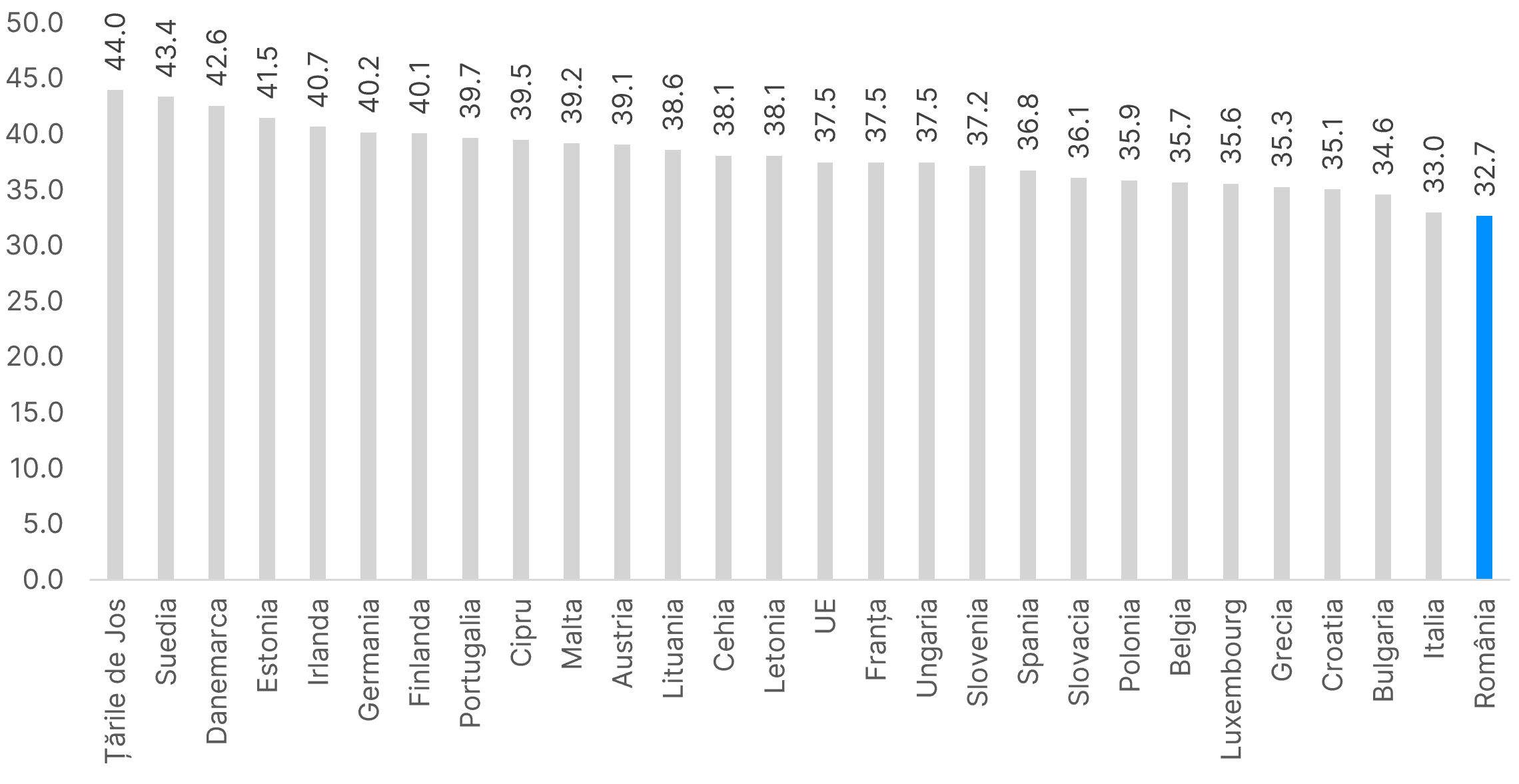
In 2025, the estimated working life in the European Union was 37.5 yearsCompared to 2015, when the indicator was 34.9 years, the duration increased by 2.6 years.
Growth is supported both by improved employment and by higher participation of women and people over 55 in the labor market. At the same time, increased life expectancy and the gradual adjustment of pension conditions extend the period of economic activity.
While the average professional working life in the EU has increased by 2.6 years over the last decade, in Romania it has decreased by 0.1 years. Thus, by the end of 2025, in our country, the average length of professional activity stood at 32.7 years, ranking last in the European Union.
Comparing the evolution of the average length of professional life, we see a clear and consistent trend over the last decade
2015: 34.9 years (EU) vs 32.8 years (Romania)
2019: 35.9 years (EU) vs 33.8 years (Romania)
2021: 35.9 years (EU) vs 31.1 years (Romania)
2023: 37 years (EU) vs 32.4 years (Romania)
2025: 37.5 years (EU) vs 32.7 years (Romania)
Gap compared to Europe has doubled in the last 10 years, from 2.1 (2015) to 4.8 years (2025).
RANKING AND TRENDS
Looking at the first and last places, we notice:
The longest working careers: the Netherlands (44 years), Sweden (43.4 years), and Denmark (42.6 years)
These results are associated with high employment rates, significant participation of women, extensive use of flexible programs, and the retention of older individuals in the labor market.
Longer duration does not automatically mean that employees work more hours each week. The Netherlands, for example, have a significant share of part-time work. The indicator shows that people remain connected to the labor market for a longer period, even if their individual schedule may be reduced or flexible.
The fewest years in the labor market: Romania (32.7 years), Italy (33 years), and Bulgaria (34.6 years)
These are the only member states with an estimated duration of less than 35 years in 2025.
While Italy historically recorded an increase from 30.7 years (2015) to 33 years (2025), and Bulgaria progressed from 32.1 to 34.6 years, in Romania, however, the 2025 figure is almost identical to that from ten years ago.
The difference between states cannot be explained solely by the retirement age. It mainly reflects the ability of savings to integrate into employment young people, women, those from rural areas, workers with a low level of education, and people nearing retirement.
WOMEN VS MEN: THE LARGEST GAP IN THE EU
In 2025, the estimated length of professional life for men and women had the following structure:
2025 (Men): 39.5 years (EU) vs 36 years (Romania)
2025 (Women): 35.5 years (EU) vs 29.1 years (Romania)
2025 (Difference): 4.1 years (EU) vs 6.9 years (Romania)
The gender gap in Romania thus reaches 6.9 years, far beyond the European average difference of 4.1 years.
Women's low participation is therefore one of the main reasons for Romania's position. In 2025, the gap between the employment rates of men and women in Romania was 18.7 percentage points, one of the largest in the European Union.
This situation is not only a social issue but also an economic one. Globally, narrowing the participation gaps between women and men is estimated to generate significant economic gains. World Bank indicates a potential growth of over 20% in global GDP, and McKinsey estimates an impact of up to USD 12 trillion in the scenario of an accelerated economic equality.
In this context, the large gap between women and men active in Romania's labor market represents not only a vulnerability of the workforce but also a untapped substantial economic opportunity. An increase in women's participation levels close to those of men could simultaneously contribute to expanding the labor force base, raising household incomes, and accelerating long-term economic growth potential.
FACTORS INFLUENCING ROMANIA'S POSITION
• Low occupancy rate – Romania remains under 70%, alongside Greece and Italy, compared to 80%+ in the Nordic countries. | • Informal Employment – Undeclared work or day labor activity not recorded in the formal workforce. | |
• Urban-rural gap – Access to formal jobs is significantly lower in rural areas, where nearly half of Romanians live. | • Migration – A significant part of Romania’s active workforce works abroad. These people do not appear in the national employment statistics. | |
• Youths enter late and with difficulty – Employment rate of recent graduates in Romania: 70.3%, compared to the EU average of 83%. That means nearly 1 in 3 newly graduated Romanians is not employed. | • High inactivity – Many people are neither employed nor looking for a job. They are not statistically unemployed; they simply do not participate in the labor market. |
WHAT'S NEXT FOR CURRENT GENERATIONS?
The issue becomes more important in the context of an aging population. Between 2005 and 2025, the median age of Romania’s population increased by 8.6 years, the highest increase in the European Union. As the large generations approach retirement, the number of active people risks declining faster than the number of pension and healthcare beneficiaries.
In this context, a shorter professional life is no longer just a statistic, but turns into direct and immediate consequences:
- Taxpayer base narrows. Fewer active people means fewer contributions to pension system. The ratio of 8 pensioners to 10 employees becomes even more strained if many of those 10 potential employees are inactive or work outside the formal system.
- The staff shortage is deepening. Romanian companies are already facing major recruitment challenges. A labor market with low participation exacerbates this issue.
- Tax revenues are decreasing. Fewer formal employees means less income tax and fewer social contributions, which means less money for the budget for health, education, and infrastructure.
- Salaries and production costs rise under pressure. When labor demand exceeds supply, wages rise, which can be good for employees but puts pressure on companies' competitiveness.
For workers over 45–50 years old, they become essential updating skills, adapting working conditions and access to flexible programs. Extending professional life cannot be achieved solely by raising the retirement age. It is necessary for people to remain healthy, productive, and able to adapt to technological changes.
WHAT LIES AHEAD FOR FUTURE GENERATIONS?
For young people entering or about to enter the workforce in the coming years, professional careers will likely be longer but less linear. Periods of employment will alternate more frequently with retraining, education, freelancing, or changing fields.
Increasing life expectancy and an aging population will put pressure on keeping people active in the workforce until older ages. At the same time, automation and artificial intelligence will change the structure of occupations, requiring continual skills updating.
Future generations will not necessarily have just one profession over 40 years, but several distinct career stages. Education will no longer be focused only at the start of life, but will need to continue throughout the entire career.
Without an increase in labor force participation, young people could face higher contributions or receive relatively lower public pensions.
ONE LOOK INTO THE FUTURE
At the European level, the length of professional life is expected to gradually increase due to an aging population, pension system reforms, and higher participation of women and older people in the labor market. However, the pace will depend on the population's health status, job quality, and access to training.
For Romania, approaching 34–35 years of working life requires reducing inactivity, increasing employment among women and young people, limiting informal work, and investing in skills development. Without these measures, the gap compared to the European average risks remaining.
A STRUCTURAL CHANGE
In the end, it is important to keep in mind that Romania is not last in the EU in terms of working life duration due to a lack of hardworking people. The data show that too many individuals enter the workforce late, exit early, or remain outside it for extended periods. Therefore, the greatest potential for growth lies not in extending the working hours of those already employed, but in involving more people in economic activity.
In an economy simultaneously affected by migration, demographic aging and with staff shortages, extending working lives becomes a condition for supporting the pension system and economic potential. The goal should not only be for people to work more years, but for them to have longer, healthier, more flexible, and more productive careers.